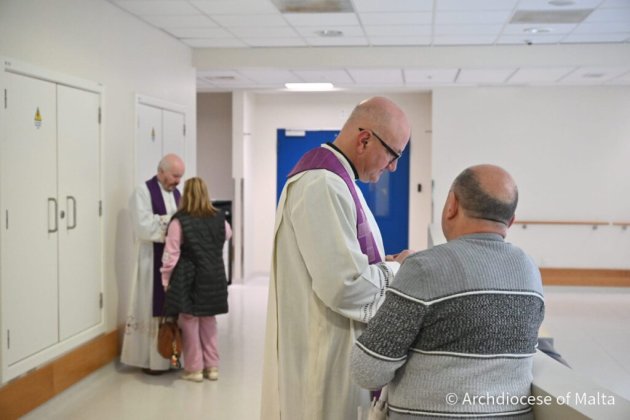
'The Gospel first reveals Jesus' love, then His power over death' – Archbishop
Archbishop Charles Scicluna offered a powerful reflection on faith and mortality during Mass for the Fifth Sunday of Lent at the Sir Anthony Mamo Oncology Centre chapel, drawing on the Gospel account of the raising of Lazarus to speak directly to those encountering death through illness [1].
Speaking to the medical professionals, patients, and staff gathered in that sacred space, the Archbishop structured his homily around two foundational truths. First, he invited those present to notice how frequently the words "Jesus loved" appear in the biblical passage describing Lazarus's death and resurrection. Before revealing his power over death, the Gospel reveals the depth of Christ's love [1].
"Jesus wept," the Archbishop quoted from the sacred text, recalling how witnesses were moved to say: "See how much he loved him." This, he emphasised, was the first truth to hold fast to — that those who suffer and grieve do not do so before an indifferent God, but before one who weeps with them [1].
The second reflection turned to the nature of Christ's power over death itself. The Archbishop was careful to clarify that the raising of Lazarus did not render him immortal in the bodily sense. "It does not mean that. Death is a law to which he himself submitted, and which we must all pass through," he explained [1]. Rather, the sign given was deliberate and precise — a demonstration that those who witness suffering and death might know they entrust themselves to one who loves them and holds power even over the grave [1].
"We are not alone as we pass through the door of death. There is someone who sustains us."
The Archbishop described death not as a wall but as a doorway opening not onto nothing, but onto a life that knows no death. To the question that rises from the human heart at the bedside of the dying — whether there is anything beyond that threshold — Christ's response resonates across the centuries: "I am the resurrection and the life. Whoever believes in me, even though he dies, will live" [1].
In a particularly touching moment, Archbishop Scicluna addressed the medical professionals, nurses, consultants, and support staff directly. He acknowledged that healthcare workers sometimes feel their skill and dedication go unrecognised when credit is instinctively attributed to divine intervention alone [1]. Instead, he called for recognition that God works through skilled and dedicated people — that medicine and faith are not in competition but in partnership [1].
Yet he also invited humility before the reality that death, however much we care for one another, cannot ultimately be evaded by human means alone [1].
The homily closed with Christ's own question to Martha, now addressed to all who heard the Archbishop's words: "Do you believe this?" — a question that the Fifth Sunday of Lent places before the faithful as the Church moves toward the solemn commemoration of the Passion and the joy of the Resurrection [1].