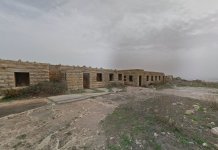
Safety concerns finally addressed after months of warnings
The Ombudsman has delivered a damning verdict on the Lands Authority's handling of safety hazards at Fort Campbell in Mellieħa, ordering that all dangerous structures on the site be blocked or cleared with immediate effect [1].
In a report issued on 23 March by Commissioner for Environment and Planning Perit Alan Saliba, the office upheld a complaint brought by the Mellieħa local council, which had been raising serious safety concerns with the authority since October 2024 [1]. The commissioner concluded that the complaint was fully justified and that the Lands Authority had fundamentally failed in its duty as a responsible custodian of a public site.
A fort in crisis
Fort Campbell, built by the British between 1937 and 1938 as the last major fortification they constructed in Malta, has deteriorated significantly over decades of neglect [1]. Vandals have stripped iron beams from its structures, causing roof collapses, and the site attracts large numbers of visitors, including children and families, particularly at weekends [1].
The local council had repeatedly requested concrete action: the physical closure and fencing of hazardous areas, the blocking of windows and apertures, and regular enforcement patrols [1]. Instead, the Lands Authority installed warning signage and relied on a legal defence that ultimately failed to hold water.
Weak defences don't wash
The authority had invoked the civil law doctrine of volenti non fit iniuria — the principle that a person who knowingly accepts a risk cannot claim damages from the property owner [1]. It also argued that undertaking capital-intensive interim fencing and structural works would be wasteful, given that a restoration project was already in the pipeline [1].
The commissioner rejected both arguments outright. A site inspection carried out on 19 March 2026 — a public holiday — found multiple visitors present on the site despite no-entry signs [1]. A warning sign previously installed 100 metres inside the site was found to be missing, and rooms with collapsing lintels and ceilings described as "hanging by a thread" were physically open and in active use by the public [1].
"Warning signs are neither sufficient to physically prevent the public from entering nor are enough to exonerate the Lands Authority from any criminal liability." — Ombudsman report [1]
No evidence was found of the ongoing enforcement the Lands Authority had claimed was in place [1]. The commissioner noted that the civil code defence only applies if the authority is acting as a bonus pater familias — a diligent and prudent custodian — and the evidence clearly showed it was not [1].
Local council vindicated
Mellieħa mayor Gabriel Micallef, who has led the council's campaign on the issue, welcomed the ruling. "This is not a political matter — it is a matter of public safety," he said. "It should never have taken this long, nor required intervention at this level, for such basic and urgent action to be acknowledged." [1]
Fort Campbell's future taking shape
The fort's future has been the subject of considerable government attention in recent months. Prime Minister Robert Abela committed last year to restoring Fort Campbell as part of a broader national parks initiative, alongside Manoel Island, White Rocks and Fort Salvatore in Kalkara [1].
Heritage organisation Fondazzjoni Wirt Artna has welcomed the restoration plan, and the Chamber of Architects has suggested the site lend itself to a contemplative heritage and ecology park rather than commercial development [1].