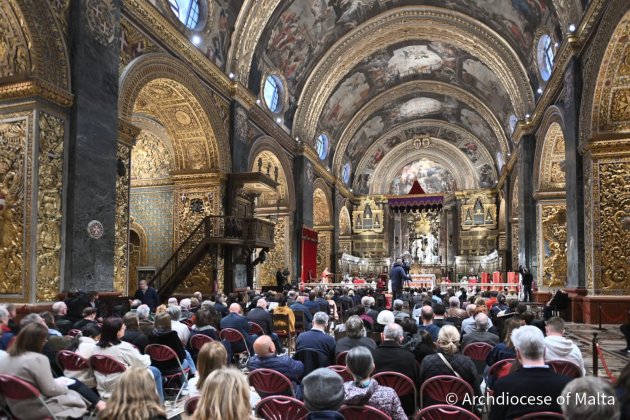
Archbishop Charles Scicluna has invited the faithful to use Holy Week as a transformative opportunity to truly understand Jesus Christ, warning that many Christians risk professing a faith they don't fully grasp. Speaking at the Palm Sunday Mass at St John's Co-Cathedral in Valletta on Sunday morning, the Archbishop presided over the blessing of olive branches and the solemn proclamation of the Passion according to Matthew, delivering a homily that struck at the heart of what it means to know Christ [1].
Drawing on the story of Peter's triple denial of Jesus, Archbishop Scicluna reflected on those fateful words: "I don't know the man." Rather than viewing this simply as an act of cowardice, the Archbishop suggested a deeper irony lies within Peter's denial – that the apostle, overcome with fear of arrest and death, had not yet understood the transformative power of Jesus' love. It was precisely on the cross where Christ's love would prove to be the ultimate victory over death [1].
"How good it would be, during this Holy Week, to come to know this man," Archbishop Scicluna said to the congregation. "To discover that he is the Son of God made man; that before the High Priest he admits he is the Messiah; that before Pilate he admits he is the King of the Jews." [1]
The Archbishop's reflection extended to the profound solitude that Christ embraced on the cross – what he described as "the terrible solitude of man, when he feels that God has abandoned him." This solitude, he explained, represents "the solitude of sin and of hell" which Jesus bore while praying Psalm 22, ultimately to liberate humanity from it [1].
His message carried a challenge to the faithful: "Do we know this man? And if we do not know him enough, let us pray for the grace, during these holy days, to come to know him more. And to meet him as our Saviour." [1]
Palm Sunday marks the beginning of Holy Week, the most solemn period in the Christian liturgical calendar. During these sacred days, the faithful commemorate Christ's entry into Jerusalem, his Last Supper, his crucifixion and death, culminating in the celebration of his Resurrection on Easter Sunday [1].
The Archbishop's message essentially invited the congregation to move beyond a superficial or fear-based faith – one that distances itself from Christ when confronted with suffering – and instead to encounter Jesus as the one who transforms even death into an expression of love [1].